Showing posts with label ATU 1696. Show all posts

November 7. Story of the Day: Stupid's Cries

This story comes from More English Fairy Tales by Joseph Jacobs.

It is an example of ATU Tale Type 1696.

Looking for more stories? Click here for previous Stories-of-the-Day.


STUPID'S CRIES

THERE was once a little boy, and his mother sent him to buy a sheep's head and pluck; afraid he should forget it, the lad kept saying all the way along:

'Sheep's head and pluck!
Sheep's head and pluck!'

Trudging alone, he came to a stile; but in getting over he fell and hurt himself, and beginning to blubber, forgot what he was sent for. So he stood a little while to consider; at last he thought he recollected it, and began to repeat:

'Liver and lights and gall and all!
Liver and lights and gall and all!'

Away he went again, and came to where a man had a pain in his liver, bawling out:

'Liver and lights and gall and all!
Liver and lights and gall and all!'

Whereon the man laid hold of him and beat him, bidding him say:

'Pray God send no more!
Pray God send no more!'

The youngster strode along, uttering these words, till he reached a field where a hind was sowing wheat:

'Pray God send no more!
Pray God send no more!'

This was all his cry. So the sower began to thrash him, and charged him to repeat:

'Pray God send plenty more!
Pray God send plenty more!'

Off the child scampered with these words in his mouth till he reached a churchyard and met a funeral, but he went on with his:

'Pray God send plenty more!
Pray God send plenty more!'

The chief mourner seized and punished him, and bade him repeat:

'Pray God send the soul to heaven!
Pray God send the soul to heaven!'

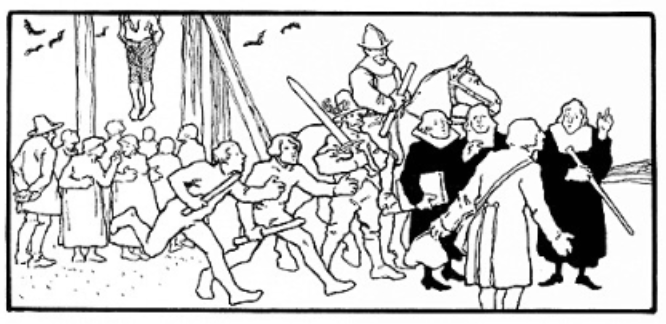
Away went the boy, and met a dog and a cat going to be hung, but his cry rang out:

'Pray God send the soul to heaven!
Pray God send the soul to heaven!'

The good folk nearby were furious, seized and struck him, charging him to say:

'A dog and a cat agoing to be hung!
A dog and a cat agoing to be hung!'

This the poor fellow did, till he overtook a man and a woman going to be married. 'Oh, oh!' he shouted:

'A dog and a cat agoing to be hung!
A dog and a cat agoing to be hung!'

The man was enraged, as we may well think, gave him many a thump, and ordered him to repeat:

'I wish you much joy!
I wish you much joy!'

This he did, jogging along, till he came to two labourers who had fallen into a ditch. The lad kept bawling out:

'I wish you much joy!
I wish you much joy!'

This vexed one of the folk so sorely that he used all his strength, scrambled out, beat the crier, and told him to say:

'The one is out, I wish the other was!
The one is out, I wish the other was!'

On went young 'un till he found a fellow with only one eye; but he kept up his song:

'The one is out, I wish the other was!
The one is out, I wish the other was!'

This was too much for Master One-eye, who grabbed him and chastised him, bidding him call:

'The one side gives good light, I wish the other did!
The one side gives good light, I wish the other did!'

So he did, to be sure, till he came to a house, one side of which was on fire. The people here thought it was he who had set the place a-blazing, and straightway put him in prison. The end was, the judge put on his black cap, and condemned him to die.

Balkoba Sangkame: Next time I'll get it right

Another story from the Marathi (India) by Shrimati Jayashreedevi Shirole, via Suniti Namjoshi (more contributions here), with notes also below the story.

This is ATU Tale Type 1696: What should I have done?

You can skip the somewhat scary clown and start the actual story at


BALKOBA SANGKAMÉ


One Sunday Balkoba Sangkame went to visit his aunt. When it was time to go home, his aunt gave him a lump of butter to take with him. Balkoba wrapped it up in a piece of paper and put it under his cap.  By the time he got home, the sun had melted the butter and it was trickling down his face.

His mother was a bit cross, but she explained to him that he should have wrapped up the butter in a banana leaf.

“Sorry,” said Balkoba. “Next time I’ll get it right.”

When Sunday came around, he went to visit his aunt again. This time she gave him a puppy. He wrapped up the puppy in a banana leaf and brought it home. The poor thing had nearly smothered to death.

His mother sighed and explained patiently that he should have tied a string around the puppy’s neck and led it back.

 “Sorry,” said Balkoba. “But next time I will get it right.”

It was Sunday again and he went to visit his aunt.  This time she gave him a jelabi to take back with him. He was determined to be careful. He tied a string around it and dragged it back.

His mother just looked at him sorrowfully and explained that jelabis are to be carried in a paper bag. And so the next time when his aunt gave him some buttermilk…

The tale of Balkoba Sangkame, who had to be told each time how to do things right, but who  managed somehow to get them wrong, is too long for one person to tell and so everyone is invited to help.


NOTES

Bal means child or boy, but when it’s turned into ‘Balkoba’  there’s a slightly sarcastic, though not unkind, tinge to it.  Marathi tends to be imbued with sarcasm and irony. Sangkamé refers to a person who has to be told to do something every single time and who never gets anything right. The word literally means ‘has to be told chores.’


Here is a video in Marathi:


Grimm (Hunt). Going A-Travelling

From Household Tales by Jacob and Wilhelm Grimm, translated by Margaret Hunt.

This is ATU Tale Type 1696.

GOING A-TRAVELLING

There was once a poor woman who had a son, who much wished to travel, but his mother said, "How canst thou travel? We have no money at all for thee to take away with thee."

Then said the son, "I will manage very well for myself; I will always say, Not much, not much, not much."

So he walked for a long time and always said, "Not much, not much, not much." Then he passed by a company of fishermen and said, "God speed you! not much, not much, not much."

"What sayst thou churl, 'not much?"' And when the net was drawn out they had not caught much fish. So one of them fell on the youth with a stick and said, "Hast thou never seen me threshing?"

"What ought I to say, then?" asked the youth.

"Thou must say, 'Get it full, get it full.'"

After this he again walked a long time, and said, "Get it full, get it full," until he came to the gallows, where they had got a poor sinner whom they were about to hang. Then said he, "Good morning; get it full, get it full."

"What sayst thou, knave, get it full? Dost thou want to make out that there are still more wicked people in the world is not this enough?" And he again got some blows on his back.

"What am I to say, then?" said he. "Thou must say, may God have pity on the poor soul."

Again the youth walked on for a long while and said, "May God have pity on the poor soul!" Then he came to a pit by which stood a knacker who was cutting up a horse. The youth said, "Good morning; God have pity on the poor soul!"

"What dost thou say, thou ill-tempered knave?" and the knacker gave him such a box on the ear, that he could not see out of his eyes.

"What am I to say, then?"

"Thou must say, 'There lies the carrion in the pit!'"

So he walked on, and always said, "There lies the carrion in the pit, there lies the carrion in the pit." And he came to a cart full of people, so he said, "Good morning, there lies the carrion in the pit!"

Then the cart pushed him into a hole, and the driver took his whip and cracked it upon the youth, till he was forced to crawl back to his mother, and as long as he lived he never went out a-travelling again.


(illustration by Otto Ubbelohde)


Grimm (Hunt). Clever Hans

From Household Tales by Jacob and Wilhelm Grimm, translated by Margaret Hunt.

This is ATU Tale Type 1696.


CLEVER HANS

(illustration by Otto Ubbelohde)


The mother of Hans said, "Whither away, Hans?"

Hans answered, "To Grethel."

"Behave well, Hans."

"Oh, I'll behave well. Good-bye, mother."

"Good-bye, Hans."

Hans comes to Grethel, "Good day, Grethel."

"Good day, Hans. What dost thou bring that is good?"

"I bring nothing, I want to have something given me." Grethel presents Hans with a needle.

Hans says, "Good-bye, Grethel."

"Good-bye, Hans."

Hans takes the needle, sticks it into a hay-cart, and follows the cart home. "Good evening, mother."

"Good evening, Hans. Where hast thou been?"

"With Grethel."

"What didst thou take her?"

"Took nothing; had something given me."

"What did Grethel give thee?"

"Gave me a needle."

"Where is the needle, Hans?"

"Stuck it in the hay-cart."

"That was ill done, Hans. Thou shouldst have stuck the needle in thy sleeve."

"Never mind, I'll do better next time."

"Whither away, Hans?"

"To Grethel, mother."

"Behave well, Hans."

"Oh, I'll behave well. Good-bye, mother."

"Good-bye, Hans."

Hans comes to Grethel. "Good day, Grethel."

"Good day, Hans. What dost thou bring that is good?"

"I bring nothing; I want to have something given to me." Grethel presents Hans with a knife.

"Good-bye, Grethel."

"Good-bye Hans."

Hans takes the knife, sticks it in his sleeve, and goes home. "Good evening, mother."

"Good evening, Hans. Where hast thou been?"

"With Grethel."

"What didst thou take her?"

"Took her nothing, she gave me something."

"What did Grethel give thee?"

"Gave me a knife."

"Where is the knife, Hans?"

"Stuck in my sleeve."

"That's ill done, Hans, thou shouldst have put the knife in thy pocket."

"Never mind, will do better next time."

"Whither away, Hans?"

"To Grethel, mother."

"Behave well, Hans."

"Oh, I'll behave well. Good-bye, mother."

"Good-bye, Hans."

Hans comes to Grethel. "Good day, Grethel."

"Good day, Hans. What good thing dost thou bring?"

"I bring nothing, I want something given me." Grethel presents Hans with a young goat.

"Good-bye, Grethel."

"Good-bye, Hans."

Hans takes the goat, ties its legs, and puts it in his pocket. When he gets home it is suffocated.

"Good evening, mother."

"Good evening, Hans. Where hast thou been?"

"With Grethel."

"What didst thou take her?"

"Took nothing, she gave me something."

"What did Grethel give thee?"

"She gave me a goat."

"Where is the goat, Hans?"

"Put it in my pocket."

"That was ill done, Hans, thou shouldst have put a rope round the goat's neck."

"Never mind, will do better next time."

"Whither away, Hans?"

"To Grethel, mother."

"Behave well, Hans."

"Oh, I'll behave well. Good-bye, mother."

"Good-bye, Hans." Hans comes to Grethel. "Good day, Grethel."

"Good day, Hans. What good thing dost thou bring?"

"I bring nothing, I want something given me." Grethel presents Hans with a piece of bacon.

"Good-bye, Grethel."

"Good-bye, Hans."

Hans takes the bacon, ties it to a rope, and drags it away behind him. The dogs come and devour the bacon. When he gets home, he has the rope in his hand, and there is no longer anything hanging to it.

"Good evening, mother."

"Good evening, Hans."

"Where hast thou been?"

"With Grethel."

"What didst thou take her?"

"I took her nothing, she gave me something."

"What did Grethel give thee?"

"Gave me a bit of bacon."

"Where is the bacon, Hans?"

"I tied it to a rope, brought it home, dogs took it."

"That was ill done, Hans, thou shouldst have carried the bacon on thy head."

"Never mind, will do better next time."

"Whither away, Hans?"

"To Grethel, mother."

"Behave well, Hans."

"I'll behave well. Good-bye, mother."

"Good-bye, Hans."

Hans comes to Grethel. "Good day, Grethel."

"Good day, Hans."

"What good thing dost thou bring?"

"I bring nothing, but would have something given." Grethel presents Hans with a calf.

"Good-bye, Grethel."

"Good-bye, Hans."

Hans takes the calf, puts it on his head, and the calf kicks his face.

"Good evening, mother."

"Good evening, Hans. Where hast thou been?"

"With Grethel."

"What didst thou take her?"

"I took nothing, but had something given me."

"What did Grethel give thee?"

"A calf."

"Where hast thou the calf, Hans?"

"I set it on my head and it kicked my face."

"That was ill done, Hans, thou shouldst have led the calf, and put it in the stall."

"Never mind, will do better next time."

"Whither away, Hans?"

"To Grethel, mother."

"Behave well, Hans."

"I'll behave well. Good-bye, mother."

"Good-bye, Hans."

Hans comes to Grethel. "Good day, Grethel."

"Good day, Hans. What good thing dost thou bring?"

"I bring nothing, but would have something given."

Grethel says to Hans, "I will go with thee."

Hans takes Grethel, ties her to a rope, leads her to the rack and binds her fast. Then Hans goes to his mother.

"Good evening, mother."

"Good evening, Hans. Where hast thou been?"

"With Grethel."

"What didst thou take her?"

"I took her nothing."

"What did Grethel give thee?"

"She gave me nothing, she came with me."

"Where hast thou left Grethel?"

"I led her by the rope, tied her to the rack, and scattered some grass for her."

"That was ill done, Hans, thou shouldst have cast friendly eyes on her."

"Never mind, will do better."

Hans went into the stable, cut out all the calves' and sheep's eyes, and threw them in Grethel's face.

Then Grethel became angry, tore herself loose and ran away, and became the bride of Hans.


ATU 1696 What should I have said (done)?


At this site:
Balkoba Sangkame: Next time I'll get it right
Jacobs. Stupid's Cries
Grimm (Hunt). Clever Hans

ATU 1696 What should I have said (done)?
motifs: J2461

J2461 Bengal Banerji 50-56; Kurukh: Hahn 22f.12 ... plus whole list of literal fools (not sure if any are chains)

arrant fool . afanasyev
fool (venice) clouston book of noodles
giufa and the wineskin calvino italian
heart liver and lights. campbell, cloudwalking
jack and the king's girl. chase, jack tales
johnny raggie comes ta grace marwick. folklore of orkney and shetland
lazy jack. clarkson and cross
lazy jack. jacobs english
silly bow bodker european folk tales
silly matt clouston book of noodles
simpleton grimm, other tales
some other small gut randolph the devil's pretty daughter
stupid drover, paredes mexico
village fool dorson buyin ghte wind
what am I to say? megas folktales of greece
what should I have said thompson 100 folktales
you shouldn't say that, karagox! walker and uysal tales in turkey