Showing posts with label Region: British. Show all posts

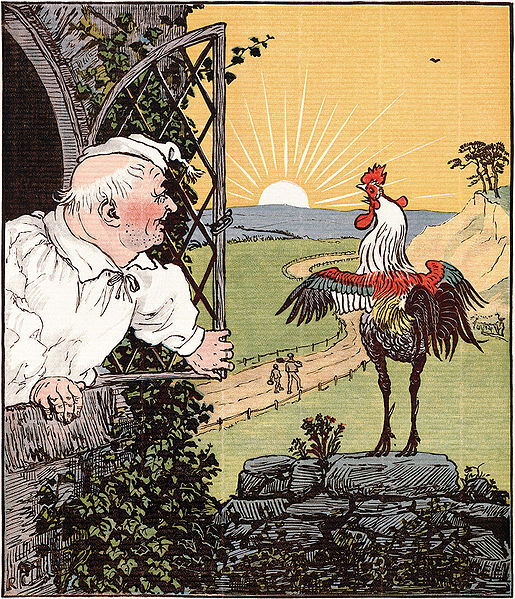
November 7. Story of the Day: Stupid's Cries

This story comes from More English Fairy Tales by Joseph Jacobs.

It is an example of ATU Tale Type 1696.

Looking for more stories? Click here for previous Stories-of-the-Day.


STUPID'S CRIES

THERE was once a little boy, and his mother sent him to buy a sheep's head and pluck; afraid he should forget it, the lad kept saying all the way along:

'Sheep's head and pluck!
Sheep's head and pluck!'

Trudging alone, he came to a stile; but in getting over he fell and hurt himself, and beginning to blubber, forgot what he was sent for. So he stood a little while to consider; at last he thought he recollected it, and began to repeat:

'Liver and lights and gall and all!
Liver and lights and gall and all!'

Away he went again, and came to where a man had a pain in his liver, bawling out:

'Liver and lights and gall and all!
Liver and lights and gall and all!'

Whereon the man laid hold of him and beat him, bidding him say:

'Pray God send no more!
Pray God send no more!'

The youngster strode along, uttering these words, till he reached a field where a hind was sowing wheat:

'Pray God send no more!
Pray God send no more!'

This was all his cry. So the sower began to thrash him, and charged him to repeat:

'Pray God send plenty more!
Pray God send plenty more!'

Off the child scampered with these words in his mouth till he reached a churchyard and met a funeral, but he went on with his:

'Pray God send plenty more!
Pray God send plenty more!'

The chief mourner seized and punished him, and bade him repeat:

'Pray God send the soul to heaven!
Pray God send the soul to heaven!'

Away went the boy, and met a dog and a cat going to be hung, but his cry rang out:

'Pray God send the soul to heaven!
Pray God send the soul to heaven!'

The good folk nearby were furious, seized and struck him, charging him to say:

'A dog and a cat agoing to be hung!
A dog and a cat agoing to be hung!'

This the poor fellow did, till he overtook a man and a woman going to be married. 'Oh, oh!' he shouted:

'A dog and a cat agoing to be hung!
A dog and a cat agoing to be hung!'

The man was enraged, as we may well think, gave him many a thump, and ordered him to repeat:

'I wish you much joy!
I wish you much joy!'

This he did, jogging along, till he came to two labourers who had fallen into a ditch. The lad kept bawling out:

'I wish you much joy!
I wish you much joy!'

This vexed one of the folk so sorely that he used all his strength, scrambled out, beat the crier, and told him to say:

'The one is out, I wish the other was!
The one is out, I wish the other was!'

On went young 'un till he found a fellow with only one eye; but he kept up his song:

'The one is out, I wish the other was!
The one is out, I wish the other was!'

This was too much for Master One-eye, who grabbed him and chastised him, bidding him call:

'The one side gives good light, I wish the other did!
The one side gives good light, I wish the other did!'

So he did, to be sure, till he came to a house, one side of which was on fire. The people here thought it was he who had set the place a-blazing, and straightway put him in prison. The end was, the judge put on his black cap, and condemned him to die.

November 5. Story of the Day: The Sprightly Tailor

This is from Celtic Fairy Tales by Joseph Jacobs, with illustrations by john Batten.

This is one of those stories with a series of body parts!

Looking for more stories? Click here for previous Stories-of-the-Day.


 THE SPRIGHTLY TAILOR


A sprightly tailor was employed by the great Macdonald, in his castle at Saddell, in order to make the laird a pair of trews, used in olden time. And trews being the vest and breeches united in one piece, and ornamented with fringes, were very comfortable, and suitable to be worn in walking or dancing. And Macdonald had said to the tailor, that if he would make the trews by night in the church, he would get a handsome reward. For it was thought that the old ruined church was haunted, and that fearsome things were to be seen there at night.

The tailor was well aware of this; but he was a sprightly man, and when the laird dared him to make the trews by night in the church, the tailor was not to be daunted, but took it in hand to gain the prize. So, when night came, away he went up the glen, about half a mile distance from the castle, till he came to the old church. Then he chose him a nice gravestone for a seat and he lighted his candle, and put on his thimble, and set to work at the trews plying his needle nimbly, and thinking about the hire that the laird would have to give him.

For some time he got on pretty well, until he felt the floor all of a tremble under his feet; and looking about him, but keeping his fingers at work, he saw the appearance of a great human head rising up through the stone pavement of the church. And when the head had risen above the surface, there came from it a great, great voice. And the voice said: " Do you see this great head of mine?"

"I see that, but I'll sew this!" replied the sprightly tailor; and he stitched away at the trews.

Then the head rose higher up through the pavement, until its neck appeared. And when its neck was shown, the thundering voice came again and said: "Do you see this great neck of mine?"

"I see that, but I'll sew this!" said the sprightly tailor and he stitched away at his trews.

Then the head and neck rose higher still, until the great shoulders and chest were shown above the ground. And again the mighty voice thundered: "Do you see this great chest of mine?"

And again the sprightly tailor replied: "I see that, but I'll sew this!" and stitched away at his trews.

And still it kept rising through the pavement, until it shook a great pair of arms in the tailor's face, and said Do you see these great arms of mine?"

"I see those, but I'll sew this! " answered the tailor; and he stitched hard at his trews, for he knew that he had no time to lose.

The sprightly tailor was taking the long stitches, when he saw it gradually rising and rising through the floor, until it lifted out a great leg, and stamping with it upon the pavement, said in a roaring voice "Do you see this great leg of mine?"

"Aye, aye: I see that, but I'll sew this!" cried the tailor; and his fingers flew with the needle, and he took such long stitches, that he was just come to the end of the trews, when it was taking up its other leg. But before it could pull it out of the pavement, the sprightly tailor had finished his task; and, blowing out his candle, and springing from off his gravestone, he buckled up, and ran out of the church with the trews under his arm. Then the fearsome thing gave a loud roar, and stamped with both his feet upon the pavement, and out of the church he went after the sprightly tailor.

Down the glen they ran, faster than the stream when the flood rides it; but the tailor had got the start and a nimble pair of legs, and he did not choose to lose the laird's reward. And though the thing roared to him to stop, yet the sprightly tailor was not the man to be beholden to a monster. So he held his trews tight, and let no darkness grow under his feet, until he had reached Saddell Castle. He had no sooner got inside the gate, and shut it, than the apparition came up to it; and, enraged at losing his prize, struck the wall above the gate, and left there the mark of his five great fingers. Ye may see them plainly to this day, if ye'll only peer close enough.

But the sprightly tailor gained his reward: for Macdonald paid him handsomely for the trews, and never discovered that a few of the stitches were somewhat long.

NOTES

Source.—Notes and Queries for December 21, 1861, to which it was communicated by "Cuthbert Bede," the author of Verdant Green, who collected it in Cantyre.

Parallels.—Miss Dempster gives the same story in her Sutherland Collection, No. vii. (referred to by Campbell in his Gaelic list, at end of vol. iv.); Mrs. John Faed, I am informed by a friend, knows the Gaelic version, as told by her nurse in her youth. Chambers' "Strange Visitor," Pop. Rhymes of Scotland, 64, of which I gave an Anglicised version in my English Fairy Tales, No. xxxii., is clearly a variant.

Remarks.—The Macdonald of Saddell Castle was a very great man indeed. Once, when dining with the Lord-Lieutenant, an apology was made to him for placing him so far away from the head of the table. "Where the Macdonald sits," was the proud response, "there is the head of the table"


November 2. Story of the Day: Hunting of the Wren

This story comes from the Journal of the Folk-Song Society. Additional versions, plus the music, online at Hathi.

This is Roud 236. It's not exactly a chain tale, but it is fun!

Looking for more stories? Click here for previous Stories-of-the-Day.


THE HUNTING OF THE WREN


I fun' a bird's nest, says Robin-a-bob-bing,
I fun' a bird's nest, says Richard to Robin,
I fun' a bird's nest, says Billy Baloo,
I fun' a bird's nest, says every one.

What will we do wi' ut? says Robin-a-bob-bing,
What will we do wi' ut? says Richard to Robin,
What will we do wi' ut? says Billy Baloo,
What will we do wi' ut? says every one.

We'll tak' ut to keepers, says Robin-a-bob-bing,
We'll tak' ut to keepers, says Richard to Robin,
We'll tak' ut to keepers, says Billy Baloo,
We'll tak' ut to keepers, says every one.

What shall we get for it? says Robin-a-bob-bing,
What shall we get for it? says Richard to Robin,
What shall we get for it? says Billy Baloo,
What shall we get for it? says every one.

Three ha-pence a piece, says Robin-a-bob-bing,
Three ha-pence a piece, says Richard to Robin,
Three ha-pence a piece, says Billy Baloo,
Three ha-pence a piece, says every one.

What shall we do wi' ut? says Robin-a-bob-bing,
What shall we do wi' ut? says Richard to Robin,
What shall we do wi' ut? says Billy Baloo,
What shall we do wi' ut? says every one.

We'll go and get drunk, says Robin-a-bob-bing,
We'll go and get drunk, says Richard to Robin,
We'll go and get drunk, says Billy Baloo,
We'll go and get drunk, says every one.

How shall we get home? says Robin-a-bob-bing,
How shall we get home? says Richard to Robin,
How shall we get home? says Billy Baloo,
How shall we get home? says every one.

We'll hire a cab, says Robin-a-bob-bing,
We'll hire a cab, says Richard to Robin,
We'll hire a cab, says Billy Baloo,
We'll hire a cab, says every one.

How shall we get in? says Robin-a-bob-bing,
How shall we get in? says Richard to Robin,
How shall we get in? says Billy Baloo,
How shall we get in? says every one.

We'll tumble in, says Robin-a-bob-bing,
We'll tumble in, says Richard to Robin,
We'll tumble in, says Billy Baloo,
We'll tumble in, says every one.

How shall we get out? says Robin-a-bob-bing,
How shall we get out? says Richard to Robin,
How shall we get out? says Billy Baloo,
How shall we get out? says every one.

Same way we got in, says Robin-a-bob-bing,
Same way we got in, says Richard to Robin,
Same way we got in, says Billy Baloo,
Same way we got in, says every one.


NOTES

2. Sung by Mr. Walter H. Birch, who learnt it from a Yorkshireman.

The second version was given to me by my brother-in-law, who heard it sun at Downton College by a fellow-student from Yorkshire. Cecil J. Sharp


October 28. Story of the Day: Keys of Canterbury,

This version of the song comes from The Nursery Rhyme Book edited by Andrew Lang.

It is classified as Roud 573: Keys of Canterbury.

Looking for more stories? Click here for previous Stories-of-the-Day.


THE KEYS OF CANTERBURY


(Tin Whistle Duet)

Oh, madam, I will give you the keys of Canterbury,
To set all the bells ringing when we shall be merry,
If you will but walk abroad with me,
If you will but walk with me.

Sir, I'll not accept of the keys of Canterbury,
To set all the bells ringing when we shall be merry;
Neither will I walk abroad with thee,
Neither will I talk with thee!

Oh, madam, I will give you a fine carved comb,
To comb out your ringlets when I am from home,
If you will but walk abroad with me,
If you will but walk with me.

Sir, I'll not accept a fine carved comb,
To comb out my ringlets when you are from home,
Neither will I walk abroad with thee,
Neither will I talk with thee!

Oh, madam, I will give you a pair of shoes of cork,
One made in London, the other made in York,
If you will but walk abroad with me,
If you will but walk with me.

Sir, I'll not accept a pair of shoes of cork,
One made in London, the other made in York,
Neither will I walk abroad with thee,
Neither will I talk with thee!

Madam, I will give you a sweet silver bell,
To ring up your maidens when you are not well,
If you will but walk abroad with me,
If you will but walk with me.

Sir, I'll not accept a sweet silver bell,
To ring up my maidens when I am not well,
Neither will I walk abroad with thee,
Neither will I talk with thee!

Oh, my man John, what can the matter be?
I love the lady and the lady loves not me!
Neither will she walk abroad with me,
Neither will she talk with me.

Oh, master dear, do not despair,
The lady she shall be, shall be your only dear;
And she will walk and talk with thee,
And she will walk with thee!

Oh, madam, I will give you the keys of my chest,
To count my gold and silver when I am gone to rest,
If you will but walk abroad with me,
If you will but talk with me.

Oh, sir, I will accept of the keys of your chest,
To count your gold and silver when you are gone to rest,
And I will walk abroad with thee,
And I will talk with thee!


October 27. Story of the Day: Sneezes

This story comes from The Nursery Rhymes of England by James Orchard Halliwell.

It is an example of ATU 2012 Days of the Week.

Looking for more stories? Click here for previous Stories-of-the-Day.


SNEEZES

If you sneeze on Monday, you sneeze for danger;
Sneeze on a Tuesday, kiss a stranger;
Sneeze on a Wednesday, sneeze for a letter;
Sneeze on a Thursday, something better;
Sneeze on a Friday, sneeze for sorrow;
Sneeze on a Saturday, see your sweetheart to-morrow.

Compare the variations in Northall's English Folk-Rhymes; there is a version from Lancashire which includes Sunday:

Sneeze on a Sunday, your safety seek:
The devil will have you the whole of the week.


October 26. Story of the Day: Cold May Night

I read this story in Folktales Told around the World by Richard M. Dorson (pp. 6-9), who took the story from Folktales of Ireland by Sean O'Sullivan, and his source in turn is Micheal O Coileain, aged 70, as recorded in 1946. For ancient testimony about this story, see The Adventures of Leithin by Douglas Hyde in the Celtic Review 10 (online at Hathi).

The story is set on the island off Achill, which is the largest of the "Irish Isles" off the Mayo coast; you can read more at Wikipedia. Old May night refers to the night of May 11, which is to say it is the old May 1 (Beltane) in the new style calendar following 1750.

The story is classified as ATU 1927.

The version below is a paraphrase of the story in my own words. I have emphasized the formulaic/cumulative features of the story in my version. I took the detail of the salmon's blood from the ATU summary (in other respects, I followed this story, which is quite different from the ATU summary with the crow-eagle framework).

Looking for more stories? Click here for previous Stories-of-the-Day.


The Cold May Night
(retold by Laura Gibbs)


There are cold nights, and colder nights, and the coldest night of all happened long, long ago on Old May Night. Who remembers the coldest night? Only the oldest animals can remember the coldest night. The Old Crow of Achill Island is one of them. But he was younger then, and stronger. Now the cold bothers him. 

One cold night not so long ago the Old Crow of the Island sought shelter in an eagle's nest that he found high atop the tallest tree. The Eagle was away hunting, and there was a hungry chick awaiting her return. The Crow killed the chick and took its place, settling himself down deep into the nest.

Not long after, the Eagle returned with food for her chick. In the dark, she did not notice that it was the Crow instead of her chick who took the food and ate it hungrily. She then settled down into the nest herself, complaining that she had never felt a colder night. 

The Crow kept quiet. 

Yet as the Eagle went on and on and on and on about the cold, the Crow could not contain himself and grumbled, "I've known colder."

"What are you talking about? You hatched only a few weeks ago!"

"Oh, there was a colder night. It was on Old May Night," the Crow replied.

"How would a young chick like yourself know anything about that?" retorted the Eagle.

They argued until dawn. Finally the Crow said to the Eagle, "If you don't believe me, go ask the Blackbird of the Forge."

So the Eagle flew off to question the Blackbird of the Forge. "Listen," said the Eagle, "I cannot remember a colder night than last night, but my chick tells me that there was an Old May Night that was colder still. He's only a few weeks old himself, so I can hardly believe him, but he told me to come ask you. And here I am."

The Blackbird of the Forge thought for a moment and then replied, "Last night was the coldest night that I have ever known, and I have been alive a very long time. Do you see this iron rod which is my perch? Every seven years, I rub my beak against the rod. It used to be many inches thick, but now it is so thin that if I rub my beak on it just one more time, it will break; that is how long I have perched here, and I have never known a colder night than last night. But if you don't believe me, go ask the Bull in the Field."

The Eagle thanked the Blackbird of the Forge and flew off to question the Bull in the Field. "Listen," said the Eagle, "I cannot remember a colder night than last night, but my chick tells me that there was an Old May Night that was colder still. He's only a few weeks old himself, so I can hardly believe him, but he told me to go ask the Blackbird of the Forge. The Blackbird does not remember a colder night than last night, but she told me to come ask you. And here I am."

The Bull of the Field thought for a moment and then replied, "Last night was the coldest night that I have ever known, and I have been alive a very long time. Do you see the fence which surrounds this field? It is made up of my horns. Every  year, I shed my horns, and when I shed my two horns this year, the fence around the field will be complete; that is how long I have dwelled here, and I have never known a colder night than last night. But if you don't believe me, go ask the Blind Salmon of the Waterfall."

The Eagle thanked the Bull in the Field and flew off to question the Blind Salmon of the Waterfall. "Listen," said the Eagle, "I cannot remember a colder night than last night, but my chick tells me that there was an Old May Night that was colder still. He's only a few weeks old himself, so I can hardly believe him, but he told me to go ask the Blackbird of the Forge. The Blackbird does not remember a colder night than last night, but she told me to go ask the Bull in the Field. The Bull does not remember a colder night than last night, but he told me to come ask you. And here I am."

The Blind Salmon of the Waterfall thought for a moment and then replied, "Yes, there was a night that was colder than last night. It was on Old May Night, many years ago. I was leaping about just trying to keep warm when the water froze right under me and I landed on the ice. Around dawn, the Old Crow flew by, and he saw me there on the ice. He swooped down and started pecking out my eye. Luckily for me, the blood coming out of my eye warmed the ice beneath me, and I was able to escape back into the water. That's how I became blind in that eye, and that's also how I know it must have been the Old Crow of the Island, and not your chick, who spent last night in your nest."

"No!" screamed the Eagle. She rushed back to her nest, but it was empty. Her chick was gone. So was the Old Crow.

And there has never been a night as cold again as that Old May Night of long ago.


October 20. Story of the Day: The Old Witch

This story comes from More English Fairy Tales by Joseph Jacobs, illustrated by John Batten.

I have not found the ATU type for this story yet, but you will recognize familiar motifs here, as the one sister acts kindly and earns a series of helpers, while her other sister does just the opposite.

Looking for more stories? Click here for previous Stories-of-the-Day.


THE OLD WITCH


ONCE upon a time there were two girls who lived with their mother and father. Their father had no work, and the girls wanted to go away and seek their fortunes.

Now one girl wanted to go to service, and her mother said she might if she could find a place. So she started for the town. Well, she went all about the town, but no one wanted a girl like her.

So she went on farther into the country, and she came to the place where there was an oven where there was lots of bread baking. And the bread said, 'Little girl, little girl, take us out, take us out. We have been baking seven years, and no one has come to take us out.' So the girl took out the bread, laid it on the ground and went on her way.

Then she met a cow, and the cow said, 'Little girl, little girl, milk me, milk me! Seven years have I been waiting, and no one has come to milk me.' The girl milked the cow into the pails that stood by. As she was thirsty she drank some, and left the rest in the pails by the cow.

Then she went on a little farther, and came to an apple-tree, so loaded with fruit that its branches were breaking down, and the tree said, 'Little girl, little girl, help me shake my fruit. My branches are breaking, it is so heavy.'

And the girl said, 'Of course I will, you poor tree.' So she shook the fruit all off, propped up the branches, and left the fruit on the ground under the tree.

Then she went on again till she came to a house. Now in this house there lived a witch, and this witch took girls into her house as servants. And when she heard that this girl had left her home to seek service, she said that she would try her, and give her good wages. The witch told the girl what work she was to do. 'You must keep the house clean and tidy, sweep the floor and the fireplace; but there is one thing you must never do. You must never look up the chimney, or something bad will befall you.'

So the girl promised to do as she was told, but one morning as she was cleaning, and the witch was out, she forgot what the witch said, and looked up the chimney. When she did this a great bag of money fell down in her lap. This happened again and again. So the girl started to go off home.

When she had gone some way she heard the witch coming after her. So she ran to the apple-tree and cried:
'Apple-tree, apple-tree, hide me,
So the old witch can't find me;
If she does she'll pick my bones,
And bury me under the marble stones.'

So the apple-tree hid her. When the witch came up she said:
'Tree of mine, tree of mine,
Have you seen a girl
With a willy-willy wag, and a long-tailed bag,
Who's stole my money, all I had?'

And the apple-tree said, 'No, mother; not for seven year.'

When the witch had gone down another way, the girl went on again, and just as she got to the cow heard the witch coming after her again, so she ran to the cow and cried:
'Cow, cow, hide me,
So the old witch can't find me;
If she does she'll pick my bones,
And bury me under the marble stones.'

So the cow hid her.

When the old witch came up, she looked about and said to the cow:
'Cow of mine, cow of mine,
Have you seen a girl
With a willy-willy wag, and a long-tailed bag,
Who's stole my money, all I had?'

And the cow said, 'No, mother, not for seven year.'

When the witch had gone off another way, the little girl went on again, and when she was near the oven she heard the witch coming after her again, so she ran to the oven and cried:
'Oven, oven, hide me,
So the old witch can't find me;
If she does she'll pick my bones,
And bury me under the marble stones.'

And the oven said, 'I've no room, ask the baker,' and the baker hid her behind the oven.

When the witch came up she looked here and there and everywhere, and then said to the baker:
'Man of mine, man of mine,
Have you seen a girl,
With a willy-willy wag, and a long-tailed bag,
Who's stole my money, all I had?'

So the baker said, 'Look in the oven.' The old witch went to look, and the oven said, 'Get in and look in the furthest corner.' The witch did so, and when she was inside the oven shut her door, and the witch was kept there for a very long time.

The girl then went off again, and reached her home with her money bags, married a rich man, and lived happy ever afterwards.

The other sister then thought she would go and do the same. And she went the same way. But when she reached the oven, and the bread said, 'Little girl, little girl, take us out. Seven years have we been baking, and no one has come to take us out', the girl said, 'No, I don't want to burn my fingers.'

So she went on till she met the cow, and the cow said, 'Little girl, little girl, milk me, milk me, do. Seven years have I been waiting, and no one has come to milk me.' But the girl said, 'No, I can't milk you, I'm in a hurry,' and went on faster.

Then she came to the apple-tree, and the apple-tree asked her to help shake the fruit. 'No, I can't; another day p'raps I may,' and went on till she came to the witch's house.

Well, it happened to her just the same as to the other girl -- she forgot what she was told, and, one day when the witch was out, looked up the chimney, and down fell a bag of money.

Well, she thought she would be off at once. When she reached the apple-tree, she heard the witch coming after her, and she cried:
'Apple-tree, apple-tree, hide me,
So the old witch can't find me;
If she does she'll pick my bones,
And bury me under the marble stones.'

But the tree didn't answer, and she ran on further. Presently the witch came up and said:
'Tree of mine, tree of mine,
Have you seen a girl,
With a willy-willy wag, and a long-tailed bag,
Who's stole my money, all I had?'

The tree said, 'Yes, mother; she's gone down that way.'

So the old witch went after her and caught her; she took all the money away from her, beat her, and sent her off home just as she was.

NOTES

SOURCE Collected by Mrs Gomme at Deptford.

PARALLELS I have a dim memory of hearing a similar tale in Australia in 1860. It is clearly parallel with the Grimms' Frau Holle, where the good girl is rewarded and the bad punished in a similar way. Perrault's Toads and Diamonds is of the same genus.

October 12. Story of the Day: Man, Horse, Ox, and Dog

This is from Townsend's version of Aesop's fables.

This is ATU 173 Life Spans Readjusted.

Looking for more stories? Click here for previous Stories-of-the-Day.


THE MAN, THE HORSE, THE OX, AND THE DOG


A Horse, Ox, and Dog, driven to great straits by the cold, sought shelter and protection from Man. He received them kindly, lighted a fire, and warmed them. He let the Horse make free with his oats, gave the Ox an abundance of hay, and fed the Dog with meat from his own table.

Grateful for these favors, the animals determined to repay him to the best of their ability. For this purpose, they divided the term of his life between them, and each endowed one portion of it with the qualities which chiefly characterized himself.

The Horse chose his earliest years and gave them his own attributes: hence every man is in his youth impetuous, headstrong, and obstinate in maintaining his own opinion.

The Ox took under his patronage the next term of life, and therefore man in his middle age is fond of work, devoted to labor, and resolute to amass wealth and to husband his resources.

The end of life was reserved for the Dog, wherefore the old man is often snappish, irritable, hard to please, and selfish, tolerant only of his own household, but averse to strangers and to all who do not administer to his comfort or to his necessities.

October 10. Story of the Day: Hedley Kow

From More English Fairy Tales by Joseph Jacobs, illustrated by John Batten. This folktale has an entry at Wikipedia. A "kow" (also known as a wirrikow or worrycow) is not the dairy animal; this is a kind of mischievous elf or hobgoblin.

Looking for more stories? Click here for previous Stories-of-the-Day.

THE HEDLEY KOW


There was once an old woman, who earned a poor living by going errands and suchlike, for the farmers' wives round about the village where she lived. It wasn't much she earned by it; but with a plate of meat at one house, and a cup of tea at another, she made shift to get on somehow, and always looked as cheerful as if she hadn't a want in the world.

Well, one summer evening as she was trotting away homewards, she came upon a big black pot lying at the side of the road.

'Now that,' said she, stopping to look at it, 'would be just the very thing for me if I had anything to put into it! But who can have left it here?' and she looked round about, as if the person it belonged to must be not far off. But she could see no one.

'Maybe it'll have a hole in it,' she said thoughtfully -- 'Ay, that'll be how they've left it lying, hinny. But then it'd do fine to put a flower in for the window; I'm thinking I'll just take it home, anyways.' And she bent her stiff old back, and lifted the lid to look inside.

'Mercy me!' she cried, and jumped back to the other side of the road; 'if it isn't brim full o' gold pieces!!'

For a while she could do nothing but walk round and round her treasure, admiring the yellow gold and wondering at her good luck, and saying to herself about every two minutes, 'Well, I do be feeling rich and grand!' But presently she began to think how she could best take it home with her; and she couldn't see any other way than by fastening one end of her shawl to it, and so dragging it after her along the road.

'It'll certainly be soon dark,' she said to herself, 'and folk'll not see what I'm bringing home with me, and so I'll have all the night to myself to think what I'll do with it. I could buy a grand house and all, and live like the Queen herself, and not do a stroke of work all day, but just sit by the fire with a cup of tea; or maybe I'll give it to the priest to keep for me, and get a piece as I'm wanting; or maybe I'll just bury it in a hole at the garden-foot, and put a bit on the chimney, between the chiney teapot and the spoons -- for ornament like. Ah! I feel so grand, I don't know myself rightly!'

And by this time being already rather tired with dragging such a heavy weight after her, she stopped to rest for a minute, turning to make sure that the treasure was safe.

But when she looked at it, it wasn't a pot of gold at all, but a great lump of shining silver!

She stared at it, and rubbed her eyes and stared at it again; but she couldn't make it look like anything but a great lump of silver. 'I'd have sworn it was a pot of gold,' she said at last, 'but I reckon I must have been dreaming. Ay, now, that's a change for the better; it'll be far less trouble to look after, and none so easy stolen; yon gold pieces would have been a sight of bother to keep 'em safe. Ay, I'm well quit of them; and with my bonny lump I'm as rich as rich -- !'

And she set off homewards again, cheerfully planning all the grand things she was going to do with her money. It wasn't very long, however, before she got tired again and stopped once more to rest for a minute or two.

Again she turned to look at her treasure, and as soon as she set eyes on it she cried out in astonishment. 'Oh, my!' said she; 'now it's a lump o' iron! Well, that beats all; and it's just real convenient! I can sell it as easy as easy, and get a lot o' penny pieces for it. Ay, hinny, an' it's much handier than a lot o' yer gold and silver as'd have kept me from sleeping o' nights thinking the neighbours were robbing me -- an' it's a real good thing to have by you in a house, ye niver can tell what ye mightn't use it for, an' it'll sell -- aye, for a real lot. Rich? I'll be just rolling!'

And on she trotted again chuckling to herself on her good luck, till presently she glanced over her shoulder, 'just to make sure it was there still', as she said to herself.

'Eh, my!' she cried as soon as she saw it; 'if it hasn't gone and turned itself into a great stone this time! Now, how could it have known that I was just terrible wanting something to hold my door open with? Ay, if that isn't a good change! Hinny, it's a fine thing to have such good luck.'

And, all in a hurry to see how the stone would look in its corner by her door, she trotted off down the hill, and stopped at the foot, beside her own little gate.

When she had unlatched it, she turned to unfasten her shawl from the stone, which this time seemed to lie unchanged and peaceably on the path beside her. There was still plenty of light, and she could see the stone quite plainly as she bent her stiff back over it, to untie the shawl end; when, all of a sudden, it seemed to give a jump and a squeal, and grew in a moment as big as a great horse; then it threw down four lanky legs, and shook out two long ears, flourished a tail, and went off kicking its feet into the air and laughing like a naughty mocking boy.

The old woman stared after it, till it was fairly out of sight.

'Well!' she said at last, 'I do be the luckiest body hereabouts! Fancy me seeing the Hedley Kow all to myself, and making so free with it, too! I can tell you, I do feel that GRAND --'

And she went into her cottage, and sat down by the fire to think over her good luck.

NOTES

SOURCE Told to Mrs Balfour by Mrs M. of S. Northumberland. Mrs M.'s mother told the tale as having happened to a person she had known when young: she had herself seen the Hedley Kow twice, once as a donkey and once as a wisp of straw. 'Kow' must not be confounded with the more prosaic animal with a 'C'.

PARALLELS There is a short reference to the Hedley Kow in Henderson, l.c., first edition, pp. 234 -- 5. Our story is shortly referred to thus: 'He would present himself to some old dame gathering sticks, in the form of a truss of straw, which she would be sure to take up and carry away. Then it would become so heavy that she would have to lay her burden down, on which the straw would become "quick", rise upright and shuffle away before her, till at last it vanished from her sight with a laugh and shout.' Some of Robin Goodfellow's pranks are similar to those of the Hedley Kow. The old woman's content with the changes is similar to that of 'Mr Vinegar'. An ascending scale of changes has been studied by Prof. Crane, Italian Popular Tales, p. 373.


September 29. Story of the Day: Red Herring.

This version of the song comes from the Journal of the Folk-Song Society. For additional versions, plus the music, online at Hathi.

This is Roud 128.

Looking for more stories? Click here for previous Stories-of-the-Day.


THE RED HERRING

O what do you think I made out of my red herring's head?
I made so good oven as ever baked bread.
So it's beagles and long-dogs and a man to whip in;
And don't you think I done well with my jolly red herring?

O what do you think I made out of my red herring's tail?
I made so good ship as ever set sail.
So it's beagles and long-dogs and a man to whip in;
And don't you think I done well with my jolly red herring?

O what do you think I made out of my red herring's ribs?
Made forty new cradles and fifty new cribs.
So it's beagles and long-dogs and a man to whip in;
And don't you think I done well with my jolly red herring?

O what do you think I made out of my red herring's guts?
I made so good dreshels as ever dreshed woats.
So it's beagles and long-dogs and a man to whip in;
And don't you think I done well with my jolly red herring?

O what do you think I made out of my red herring's navel?
As good an old putt as ever drawed gravel.
So it's beagles and long-dogs and a man to whip in;
And don't you think I done well with my jolly red herring?

O what do you think I made out of my red herring's whole?
I made as good waggon as ever hauled coal.
So it's beagles and long-dogs and a man to whip in;
And don't you think I done well with my jolly red herring?


NOTES

Sung by Mrs. Louie Hooper at Hambridge, Somerset, Aug. 18th, 1904. Noted by Cecil J. Sharp.


September 28. Story of the Day: The Woman and the Berries

This version comes from The McCloskey Primer by Margaret Orvis McCloskey, with illustrations by Charles Copeland. For a Scots version, see Chalmers' Popular Rhymes of Scotland: The Wife and her Bush of Berries (online at Hathi).

This is classified as ATU 2030 The old woman and her pig.

Looking for more stories? Click here for previous Stories-of-the-Day.


THE WOMAN
AND HER BEAUTIFUL BUSH OF BERRIES


There was a woman who had a beautiful bush of berries, and she wanted to pick them, but she could not do that unless she had somebody to keep her house. So she went to a kid and said, "Kid, kid, come and keep my house till I pick my beautiful bush of berries."

"Indeed, no," said the kid, "I'll not keep your house till you pick your beautiful bush of berries."

Then the woman went to a dog and said, "Dog, dog, bite kid; kid will not keep my house till I pick my beautiful bush of berries."


"Indeed," said the dog, "I'll not bite the kid, for the kid never did me any harm."

Then the woman went to a stick and said, "Stick, stick, beat dog; dog will not bite kid, and kid will not keep my house till I pick my beautiful bush of berries."

"Indeed," said the stick, "I'll not beat the dog, for the dog never did me any harm."

Then the woman went to a fire and said, "Fire, fire, burn stick; stick will not beat dog, dog will not bite kid, and kid will not keep my house till I pick my beautiful bush of berries."

"Indeed," said the fire, I'll not burn the stick, for the stick never did me any harm."

Then the woman went to some water and said, "Water, water, quench fire; fire will not burn stick, stick will not beat dog, dog will not bite kid, and kid will not keep my house till I pick my beautiful bush of berries."

"Indeed," said the water, "I'll not quench the fire, for the fire never did me any harm."

Then the woman went to an ox and said, "Ox, ox, drink water; water will not quench fire, fire will not burn stick, stick will not beat dog, dog will not bite kid, and kid will not keep my house till I pick my beautiful bush of berries."


"Indeed," said the ox, "I'll not drink the water, for the water never did me any harm."

Then the woman went to an ax and said, "Ax, ax, strike ox; ox will not drink water, water will not quench fire, fire will not burn stick, stick will not beat dog, dog will not bite kid, and kid will not keep my house till I pick my beautiful bush of berries."

"Indeed," said the ax, "I'll not strike the ox, for the ox never did me any harm."

Then the woman went to a smith and said, "Smith, smith, grind ax; ax will not strike ox, ox will not drink water, water will not quench fire, fire will not burn stick, stick will not beat dog, dog will not bite kid, and kid will not keep my house till I pick my beautiful bush of berries."


"Indeed," said the smith, "I'll not grind the ax, for the ax never did me any harm."

Then the woman went to a rope and said, "Rope, rope, hang smith; smith will not grind ax, ax will not strike ox, ox will not drink water, water will not quench fire, fire will not burn stick, stick will not beat dog, dog will not bite kid, and kid will not keep my house till I pick my beautiful bush of berries."

"Indeed," said the rope, "I'll not hang the smith, for the smith never did me any harm."

Then the woman went to a mouse and said, "Mouse, mouse, gnaw rope; rope will not hang smith, smith will not grind ax, ax will not strike ox, ox will not drink water, water will not quench fire, fire will not burn stick, stick will not beat dog, dog will not bite kid, and kid will not keep my house till I pick my beautiful bush of berries."


"Indeed," said the mouse, "I'll not gnaw the rope, for the rope never did me any harm."

Then the woman went to a cat and said, "Cat, cat, kill mouse; mouse will not gnaw rope, rope will not hang smith, smith will not grind ax, ax will not strike ox, ox will not drink water, water will not quench fire, fire will not burn stick, stick will not beat dog, dog will not bite kid, and kid will not keep my house till I pick my beautiful bush of berries."


"Indeed," said the cat, "I'll not kill the mouse, for the mouse never did me any harm."

"Do it," said the woman, "and I'll give you milk and bread."

With that, the cat ran to kill the mouse, the mouse rang to gnaw the rope, the rope ran to hang the smith, the smith ran to to grind the ax, the ax ran to strike the ox, the ox ran to drink the water, the water ran to quench the fire, the fire ran to burn the stick, the stick ran to beat the dog, the dog ran to bite the kid, and the kid kept the woman's house till she picked her beautiful bush of berries.


NOTES

The refractory kid of this Scotch tale is very close to the pig that would not get over the stile. The series of personages in the Scotch story is almost the same as that of "The Old Woman and her Pig," and in one version the likeness is made complete by the following introduction:
There was a wife that lived in a wee house by herself, and as she was sweepin the house one day she found twal (two) pennies. So she thought to herself what she wad do wi her twal pennies, and at last she thought she couldna do better than gang wi't to the market and buy a kid. Sae she gaed to the market and coffed a fine kid. And as she was gaun home, she spied a bonny bush of berries growin beside a brig. And she said to the kid, "Kid, kid, keep my house," etc.

September 27. Story of the Day: The house that Jack built.

Here is the version from The Nursery Rhyme Book edited by Andrew Lang.

This is ATU 2035. The House that Jack Built. See also Roud 20584.

Looking for more stories? Click here for previous Stories-of-the-Day.


THE HOUSE THAT JACK BUILT

This is the house that Jack built.

This is the malt
That lay in the house that Jack built.

This is the rat,
That ate the malt,
That lay in the house that Jack built.

This is the cat,
That kill'd the rat,
That ate the malt,
That lay in the house that Jack built.

This is the dog,
That worried the cat,
That kill'd the rat,
That ate the malt,
That lay in the house that Jack built.

This is the cow with the crumpled horn,
That toss'd the dog,
That worried the cat,
That kill'd the rat,
That ate the malt,
That lay in the house that Jack built.

This is the maiden all forlorn,
That milk'd the cow with the crumpled horn,
That tossed the dog,
That worried the cat,
That kill'd the rat,
That ate the malt,
[251]That lay in the house that Jack built.

This is the man all tatter'd and torn,
That kissed the maiden all forlorn,
That milk'd the cow with the crumpled horn,
That tossed the dog,
That worried the cat,
That kill'd the rat,
That ate the malt,
That lay in the house that Jack built.

This is the priest all shaven and shorn,
That married the man all tatter'd and torn,
That kiss'd the maiden all forlorn,
That milk'd the cow with the crumpled horn,
That tossed the dog,
That worried the cat,
That kill'd the rat,
That ate the malt,
That lay in the house that Jack built.

This is the cock that crow'd in the morn,
That waked the priest all shaven and shorn,
That married the man all tatter'd and torn,
That kiss'd the maiden all forlorn,
That milk'd the cow with the crumpled horn,
That tossed the dog,
That worried the cat,
That kill'd the rat,
That ate the malt,
That lay in the house that Jack built.

This is the farmer sowing his corn,
That kept the cock that crow'd in the morn,
That waked the priest all shaven and shorn,
That married the man all tatter'd and torn,
That kissed the maiden all forlorn,
That milk'd the cow with the crumpled horn,
That tossed the dog,
That worried the cat,
That kill'd the rat,
That ate the malt,
That lay in the house that Jack built.


September 19. Story of the Day: Johnny-Cake

This story comes from Joseph Jacobs' English Fairy Tales.

It's an example of ATU 2025. The Fleeing Pancake.

Looking for more stories? Click here for previous Stories-of-the-Day.


Johnny-Cake

ONCE upon a time there was an old man, and an old woman, and a little boy. One morning the old woman made a Johnny-cake, and put it in the oven to bake. 'You watch the Johnny-cake while your father and I go out to work in the garden.' So the old man and the old woman went out and began to hoe potatoes, and left the little boy to tend the oven. But he didn't watch it all the time, and all of a sudden he heard a noise, and he looked up and the oven door popped open, and out of the oven jumped Johnny-cake, and went rolling along end over end, towards the open door of the house.


The little boy ran to shut the door, but Johnny-cake was too quick for him and rolled through the door, down the steps, and out into the road long before the little boy could catch him. The little boy ran after him as fast as he could clip it, crying out to his father and mother, who heard the uproar, and threw down their hoes and gave chase too. But Johnny-cake outran all three a long way, and was soon out of sight, while they had to sit down, all out of breath, on a bank to rest.

On went Johnny-cake, and by and by he came to two well-diggers who looked up from their work and called out: 'Where ye going, Johnny-cake?'

He said: 'I've outrun an old man, and an old woman, and a little boy, and I can outrun you, too-o-o!'

'Ye can, can ye? We'll see about that?' said they; and they threw down their picks and ran after him, but couldn't catch up with him, and soon they had to sit down by the roadside to rest.

On ran Johnny-cake, and by and by he came to two ditch-diggers who were digging a ditch. 'Where ye going, Johnnycake?' said they. He said: 'I've outrun an old man, and an old woman, and a little boy, and two well-diggers, and I can outrun you, too-o-o!'

'Ye can, can ye? We'll see about that!' said they; and they threw down their spades, and ran after him, too. But Johnnycake soon outstripped them also, and seeing they could never catch him, they gave up the chase and sat down to rest.

On went Johnny-cake, and by and by he came to a bear.

The bear said: 'Where are ye going, Johnny-cake?'

He said: 'I've outrun an old man, and an old woman, and a little boy, and two well-diggers, and two ditch-diggers, and I can outrun you, too-o-o!'

'Ye can, can ye?' growled the bear. 'We'll see about that!' and trotted as fast as his legs could carry him after Johnny-cake, who never stopped to look behind him. Before long the bear was left so far behind that he saw he might as well give up the hunt first as last, so he stretched himself out by the roadside to rest.

On went Johnny-cake, and by and by he came to a wolf. The wolf said: 'Where ye going, Johnny-cake?'

He said: 'I've outrun an old man, and an old woman, and a little boy, and two well-diggers, and two ditch-diggers, and a bear, and I can outrun you, too-o-o!'

'Ye can, can ye?' snarled the wolf'. 'We'll see about that!'

And he set into a gallop after Johnny-cake, who went on and on so fast that the wolf, too, saw there was no hope of overtaking him, and he, too, lay down to rest.

On went Johnny-cake, and by and by he came to a fox that lay quietly in a corner of the fence. The fox called out in a sharp voice, but without getting up: 'Where ye going, Johnnycake?'

He said: 'I've outrun an old man, and an old woman, and a little boy, and two well-diggers, and two ditch-diggers, a bear, and a wolf, and I can outrun you, too-o-o!'

The fox said: 'I can't quite hear you, Johnny-cake; won't you come a little closer?' turning his head a little to one side.

Johnny-cake stopped his race for the first time, and went a little closer, and called out in a very loud voice: 'I've outrun an old man, and an old woman, and a little boy, and two well-diggers, and two ditch-diggers, and a bear, and a wolf, and I can outrun you, too-o-o.'

'Can't quite hear you; won't you come a little closer?' said the fox in a feeble voice, as he stretched out his neck towards Johnny-cake, and put one paw behind his ear.

Johnny-cake came up close, and leaning towards the fox screamed out: 'I'VE OUTRUN AN OLD MAN, AND AN OLD WOMAN, AND A LITTLE BOY, AND TWO WELL-DIGGERS, AND TWO DITCH-DIGGERS, AND A BEAR, AND A WOLF, AND I CAN OUTRUN YOU, TOO-O-O!'

'You can, can you?' yelped the fox, and he snapped up the Johnny-cake in his sharp teeth in the twinkling of an eye.


NOTES

SOURCE American Journal of Folk-Lore, ii, 60 (cf. No. for July 1891).


PARALLELS Another variant is given in the same Journal, p. 277, where reference is also made to a version, 'The Gingerbread Boy', in St Nicholas, May 1875. Chambers gives two versions of the same story, under the title 'The Wee Bunnock', the first of which is one of the most dramatic and humorous of folk-tales. Unfortunately, the Scotticisms are so frequent as to render the Droll practically untranslatable. I have, however, made an attempt in More English Fairy Tales, 57. Also in Ireland as 'The Wonderful Cake' (Kennedy, Fireside Stories, p. 19). 'The Fate of Mr Jack Sparrow' in Uncle Remus is similar to that of Johnny-Cake.

September 17. Story of the Day: Milking Pails

This is one of the games reported by Alice Bertha Gomme in The Traditional Games of England, Scotland, and Ireland (volume 1).

The game-song is classified as Roud 3515.

Looking for more stories? Click here for previous Stories-of-the-Day.


MILKING PAILS


Mary's gone a-milking,
Mother, mother,
Mary's gone a-milking.
 Gentle sweet mother o' mine.

Take your pails and go after her,
Daughter, daughter,
Take your pails and go after her,
 Gentle sweet daughter o' mine.

Buy me a pair of new milking pails,
Mother, mother,
Buy me a pair of new milking pails,
 Gentle sweet mother o' mine.

Where's the money to come from,
Daughter, daughter,
Where's the money to come from,
 Gentle sweet daughter o' mine?

Sell my father's feather bed,
Mother, mother,
Sell my father's feather bed,
 Gentle sweet mother o' mine.

What's your father to sleep on,
Daughter, daughter,
What's your father to sleep on.
 Gentle sweet daughter o' mine?

Put him in the truckle bed,
Mother, mother,
Put him in the truckle bed.
 Gentle sweet mother o' mine.

What are the children to sleep on,
Daughter, daughter,
What are the children to sleep on.
 Gentle sweet daughter o' mine?

Put them in the pig-sty.
Mother, mother,
Put them in the pig-sty,
 Gentle sweet mother o' mine.

What are the pigs to lie in,
Daughter, daughter,
What are the pigs to he in.
 Gentle sweet daughter o' mine?

Put them in the washing-tubs,
Mother, mother,
Put them in the washing-tubs,
 Gentle sweet mother o' mine.

What am I to wash in,
Daughter, daughter,
What am I to wash in,
 Gentle sweet daughter o' mine?

Wash in the thimble,
Mother, mother,
Wash in the thimble,
 Gentle sweet mother o' mine.

Thimble won't hold your father's shirt,
Daughter, daughter,
Thimble won't hold your father's shirt,
 Gentle sweet daughter o' mine.

Wash in the river,
Mother, mother,
Wash in the river,
 Gentle sweet mother o' mine.

Suppose the clothes should blow away,
Daughter, daughter,
Suppose the clothes should blow away,
 Gentle sweet daughter o' mine?

Set a man to watch them,
Mother, mother,
Set a man to watch them,
 Gentle sweet mother o' mine.

Suppose the man should go to sleep,
Daughter, daughter,
Suppose the man should go to sleep,
 Gentle sweet daughter o' mine?

Take a boat and go after them,
Mother, mother,
Take a boat and go after them,
 Gentle sweet mother o' mine.

Suppose the boat should be upset,
Daughter, daughter,
Suppose the boat should be upset,
 Gentle sweet daughter o' mine?

Then that would be an end of you,
Mother, mother,
Then that would be an end of you,
 Gentle sweet mother o' mine.


NOTES

As sung by A. K. Goninie, London nursemaid, 1876.

[Gomme gives numerous versions and variations on these lyrics that you can read online.]

One child stands apart and personates the Mother. The other children form a line, holding hands and facing the Mother. They advance and retire singing the first, third, and alternate verses, while the Mother, in response, sings the second and alternate verses. While the last verse is being sung the children all run off; the Mother runs after them, catches them, and beats them. Either the first or last caught becomes Mother in next game.

In the Shropshire game the Mother should carry a stick.

In the Norfolk version the Mother sits on a form or bank, the other children advancing and retiring as they sing. After the last verse is sung the children try to seat themselves on the form or bank where the Mother has been sitting. If they can thus get home without the Mother catching them they are safe.

The Kentish game is played with two lines of children advancing and retiring. This was also the way in which the London version (A. B. Gomme) was played.

In the version sent by Mr. H. S. May a ring is formed by the children joining hands. One child stands in the centre — she represents the Mother. The ring of children say the first, third, and every alternate verse. The child in the centre says the second, fourth, and alternate verses, and the game is played as above, except that when the Mother has said the last verse the children call out, "Good job, too," and run off, the Mother chasing them as above. The game does not appear to be sung.

This game is somewhat of a cumulative story, having for its finish the making angry and tormenting of a mother. All the versions point to this.

One interesting point, that of milk-pails, is, it will be seen, gradually losing ground in the rhymes. Milk-pails were pails of wood suspended from a yoke worn on the milkmaid's shoulders, and these have been giving place to present-day milk-cans. Consequently we find in the rhymes only four versions in which milk-pails are used. In two versions even the sense of milking-can has been lost, and the South Shields version, sent me by little Miss Blair, has degenerated into "male-scales," a thoroughly meaningless phrase. The Cowes version (Miss Smith) has arrived at "wash-pan."

The "burden" of the Chirbury version is "a rea, a ria, a roses," and the Sheffield is also remarkable : the "I, O, OM " refers, probably, to something now forgotten, or it may be the "Hi, Ho, Ham!" familiar in many nursery rhymes.

The game seems to point to a period some time back, when milking was an important phase of the daily life, or perhaps to the time when it was customary for the maids and women of a village to go to the hilly districts with the cows (summer shealings) for a certain period of time.

The references to domestic life are interesting. The scarcity of beds, the best or feather bed, and the children's bed, seeming to be all those available. The feather bed is still a valued piece of household furniture, and is considered somewhat of the nature of a heirloom, feather beds often descending from mother to daughter for some generations. I have been told instances of this.

Gregor, in Folk-lore of East of Scotland, p. 52, describes the Scottish box-bed. The "truckle bed " and "footman's bed " probably refers to the small bed under a large one, which was only pulled out at night for use, and pushed under during the day. Illustrations of these beds and the children's bed are given in old tales.

The proximity of the pig-sty to the house is manifest.

The mention of washing-tubs calls to mind the large wooden tubs formerly always used for the family wash, Before the era of laundresses washing-tubs must have constituted an important part of the family plenishing. Washing in the rivers and streams was also a thing of frequent occurrence, hot water for the purpose of cleansing clothes not being considered necessary, or in many cases desirable.

Chambers gives a version of the game (Popular Rhymes, p. 36) and also Newell (Games, p. 166). Another version from Buckingham is given by Thomas Baker in the Midland Garner, 1st series, ii. 32, in which the mother desires the daughter to "milk in the washing-tub," and the words also appear very curiously tacked on to the "Three Dukes a-riding  game from Berkshire (Antiquary, xxvii. 195), where they are very much out of place.


September 16. Story of the Day: Aiken Drum

This sone comes from A Book of Nursery Songs and Rhymes by Sabine Baring-Gould.

This is Roud 2571. See Chalmers' Popular Rhymes of Scotland for another version and with music (online at Hathi).

Looking for more stories? Click here for previous Stories-of-the-Day.


AIKEN DRUM


There was a man lived in the moon,
And his name was Aiken Drum.
And he played upon a ladle,
And his name was Aiken Drum.

And his hat was made of good cream cheese,
And his name was Aiken Drum.
And he played upon a ladle,
And his name was Aiken Drum.

And his coat was made of good roast beef,
And his name was Aiken Drum.
And he played upon a ladle,
And his name was Aiken Drum.

And his buttons were made of penny loaves,
AAnd his name was Aiken Drum.
And he played upon a ladle,
And his name was Aiken Drum.

His waistcoat was made of crusts of pies,
And his name was Aiken Drum.
And he played upon a ladle,
And his name was Aiken Drum.

His breeches were made of haggis bags,
And his name was Aiken Drum.
And he played upon a ladle,
And his name was Aiken Drum.

There was a man in another town,
And his name was Willy Wood,
And he played upon a razor,
And his name was Willy Wood.

And he ate up all the good cream cheese,
And his name was Willy Wood,
And he played upon a razor,
And his name was Willy Wood.

And he ate up all the good roast beef,
And his name was Willy Wood,
And he played upon a razor,
And his name was Willy Wood.

And he ate up all the penny loaves,
And his name was Willy Wood,
And he played upon a razor,
And his name was Willy Wood.

And he ate up all the crusts of pies,
And his name was Willy Wood,
And he played upon a razor,
And his name was Willy Wood.

But he choked himself with the haggis bags,
And there was an end of Willy Wood.

September 14. Story of the Day: Man, Son, and Ass

This is from Aesop's Fables by Lena Dalkeith. It's not exactly a chain tale, but it has a great series of permutations from one way of riding/walking to another to another until the unhappy conclusion.

This is not a classical Aesop's fable, but you can find it in the medieval and later Aesop; here are some more English versions.

The story is classified as ATU 1215.

Looking for more stories? Click here for previous Stories-of-the-Day.


THE MAN, HIS SON AND HIS ASS


(illustration by S. R. Praeger)

A man and his son were leading their ass to market. A girl, seeing them, cried, "Why walk when you can ride?"

On hearing this, the man set his son upon the ass.

Going further, they heard an old man say, "Shame for the young to ride while old people walk!"

Thereupon the man made his son get down and rode himself.

Presently they met some women who cried, "Look at the poor tired son and lazy father!"

Hearing this, the man took his son up beside him and so they rode into the town.

There a young man called to them, "Two men on one beast! It seems to me you are more fit to carry the ass than he is to carry you."

Then they got down, tied the beast's legs to a pole, and carried him thus till they came to a bridge.

As they went, the children shouted so loudly that the ass took fright, kicked his legs free, and jumped over the bridge into the river.

Thus having lost his ass, the man went home, crying, "Try to please everybody and you will please nobody, not even yourself!"


September 10. Story of the Day: Farmer and His Dogs

This is from Aesop's Fables by V. S. Vernon Jones. Although it is not a chain tale, you will see that it features a very ominous series of animals who are eaten, one by one.

You can see more English versions of the fable here.

Looking for more stories? Click here for previous Stories-of-the-Day.


THE FARMER AND HIS DOGS


A Farmer was snowed up in his farmstead by a severe storm, and was unable to go out and procure provisions for himself and his family.

So he first killed his sheep and used them for food.

Then, as the storm still continued, he killed his goats.

And, last of all, as the weather showed no signs of improving, he was compelled to kill his oxen and eat them.

When his Dogs saw the various animals being killed and eaten in turn, they said to one another, "We had better get out of this or we shall be the next to go!"

September 6. Story of the Day: Munachar and Manachar

This story is from Celtic Fairy Tales by Joseph Jacobs with illustrations by John Batten, and Jacobs in turn used Irish and Scottish sources.

This is another example of ATU 2030 The old woman and her pig.

Looking for more stories? Click here for previous Stories-of-the-Day.


 MUNACHAR AND MANACHAR


THERE once lived a Munachar and a Manachar, a long time ago, and it is a long time since it was, and if they were alive now they would not be alive then. They went out together to pick raspberries, and as many as Munachar used to pick Manachar used to eat. Munachar said he must go look for a rod to make a gad to hang Manachar, who ate his raspberries every one; and he came to the rod. "What news the day?" said the rod. "It is my own news that I'm seeking. Going looking for a rod, a rod to make a gad, a gad to hang Manachar, who ate my raspberries every one."

"You will not get me," said the rod, "until you get an axe to cut me." He came to the axe. "What news today?" said the axe. "It's my own news I'm seeking. Going looking for an axe, an axe to cut a rod, a rod to make a gad, a gad to hang Manachar, who ate my raspberries every one."

"You will not get me," said the axe, "until you get a flag to edge me." He came to the flag. "What news today?" says the flag. "It's my own news I'm seeking. Going looking for a flag, flag to edge axe, axe to cut a rod, a rod to make a gad, a gad to hang Manachar, who ate my raspberries every one."

"You will not get me," says the flag, "till you get water to wet me." He came to the water. "What news today?" says the water. "It's my own news that I'm seeking. Going looking for water, water to wet flag to edge axe, axe to cut a rod, a rod to make a gad, a gad to hang Manachar, who ate my raspberries every one."

''You will not get me," said the water, "until you get a deer who will swim me." He came to the deer. "What news to-day?" says the deer. "It's my own news I'm seeking. Going looking for a deer, deer to swim water, water to wet flag, flag to edge axe, axe to cut a rod, a rod to make a gad, a gad to hang Manachar, who ate my raspberries every one."

"You will not get me," said the deer, ''until you get a hound who will hunt me." He came to the hound. "What news to-day?" says the hound. "It's my own news I'm seeking. Going looking for a hound, hound to hunt deer, deer to swim water, water to wet flag, flag to edge axe, axe to cut a rod, a rod to make a gad, a gad to hang Manachar, who ate my raspberries every one."

"You will not get me," said the hound, ''until you get a bit of butter to put in my claw." He came to the butter. "What news to-day?" says the butter. "It's my own news I'm seeking. Going looking for butter, butter to go in claw of hound, hound to hunt deer, deer to swim water, water to wet flag, flag to edge axe, axe to cut a rod, a rod to make a gad, a gad to hang Manachar, who ate my raspberries every one."

"You will not get me," said the butter, "until you get a cat who shall scrape me." He came to the cat. "What news to-day?" said the cat. "It's my own news I'm seeking. Going looking for a cat, cat to scrape butter, butter to go in claw of hound, hound to hunt deer, deer to swim water, water to wet flag, flag to edge axe, axe to cut a rod, a rod to make a gad, gad to hang Manachar, who ate my raspberries every one."

"You will not get me," said the cat, "until you will get milk which you will give me." He came to the cow. "What news to-day?" said the cow. "It's my own news I'm seeking. Going looking for a cow, cow to give me milk, milk I will give to the cat, cat to scrape butter, butter to go in claw of hound, hound to hunt deer, deer to swim water, water to wet flag, flag to edge axe, axe to cut a rod, a rod to make a gad, a gad to hang Manachar, who ate my raspberries every one."

"You will not get any milk from me," said the cow, "until you bring me a whisp of straw from those threshers yonder." He came to the threshers. "What news to-day?" said the threshers. "It's my own news I'm seeking. Going looking for a whisp of straw from ye to give to the cow, the cow to give me milk, milk I will give to the cat, cat to scrape butter, butter to go in claw of hound, hound to hunt deer, deer to swim water, water to wet flag, flag to edge axe, axe to cut a rod, a rod to make a gad, a gad to hang Manachar, who ate my raspberries every one."

"You will not get any whisp of straw from us," said the threshers, "until you bring us the makings of a cake from the miller over yonder." He came to the miller. "What news to-day?" said the miller. "It's my own news I'm seeking. Going looking for the makings of a cake which I will give to the threshers, the threshers to give me a whisp of straw, the whisp of straw I will give to the cow, the cow to give me milk, milk I will give to the cat, cat to scrape butter, butter to go in claw of hound, hound to hunt deer, deer to swim water, water to wet flag, flag to edge axe, axe to cut a rod, a rod to make a gad, a gad to hang Manachar, who ate my raspberries every one."

"You will not get any makings of a cake from me," said the miller, "till you bring me the full of that sieve of water from the river over there."

He took the sieve in his hand and went over to the river, but as often as ever he would stoop and fill it with water, the moment he raised it the water would run out of it again, and sure, if he had been there from that day till this, he never could have filled it. A crow went flying by him, over his head. "Daub! daub!" said the crow. "My blessings on ye, then," said Munachar, "but it's the good advice you have," and he took the red clay and the daub that was by the brink, and he rubbed it to the bottom of the sieve, until all the holes were filled, and then the sieve held the water, and he brought the water to the miller, and the miller gave him the makings of a cake, and he gave the makings of the cake to the threshers, and the threshers gave him a whisp of straw, and he gave the whisp of Straw to the cow, and the cow gave him milk, the milk he gave to the cat, the cat scraped the butter, the butter went into the claw of the hound, the hound hunted the deer, the deer swam the water, the water wet the flag, the flag sharpened the axe, the axe cut the rod, and the rod made a gad, and when he had it ready to hang Manachar he found that Manachar had BURST.


 NOTES

Source.—I have combined the Irish version given by Dr. Hyde in his Leabhar Sgeul., and translated by him for Mr. Yeats' Irish Folk and Fairy Tales, and the Scotch version given in Gaelic and English by Campbell, No. viii.

Parallels.—Two English versions are given in my Eng. Fairy Tales, No. iv., "The Old Woman and her Pig," and xxxiv., "The Cat and the Mouse," where see notes for other variants in these isles. M. Cosquin, in his notes to No. xxxiv., of his Contes de Lorraine, t. ii. pp.35-41, has drawn attention to an astonishing number of parallels scattered through all Europe and the East (cf, too, Crane, Ital. Pop. Tales, notes, 372-5). One of the earliest allusions to the jingle is in Don Quixote, pt. I, c. xvi.: "Y asi como suele decirse el gato al rato, el rato á la cuerda, la cuerda al palo, daba el arriero á Sancho, Sancho á la moza, la moza á él, el ventero á la moza." As I have pointed out, it is used to this day by Bengali women at the end of each folk-tale they recite (L. B. Day, Folk-Tales of Bengal, Pref.).

Remarks.—Two ingenious suggestions have been made as to the origin of this curious jingle, both connecting it with religious ceremonies: (1) Something very similar occurs in Chaldaic at the end of the Jewish Hagada, or domestic ritual for the Passover night. It has, however, been shown that this does not occur in early MSS. or editions, and was only added at the end to amuse the children after the service, and was therefore only a translation or adaptation of a current German form of the jingle; (2) M. Basset, in the Revue des Traditions poplaires, 1890, t. v. p.549, has suggested that it is a survival of the old Greek custom at the sacrifice of the Bouphonia for the priest to contend that he had not slain the sacred beast, the axe declares that the handle did it, the handle transfers the guilt further, and so on. This is ingenious, but fails to give any reasonable account of the diffusion of the jingle in countries which have had no historic connection with classical Greece.